Breast Augmentation in Westmount
What is breast augmentation?
Breast augmentation increases breast volume using an implant placed through a short incision. It is the most requested aesthetic operation in the world, and also the one where the gap between a considered result and an obvious one is widest. The difference is rarely the implant itself. It is the match between the device and the chest it is placed on.
Three measurements govern that match: the width of your chest wall, the amount of breast tissue already present, and the quality and elasticity of the skin covering it. An implant wider than the breast footprint will sit visibly outside it. One placed under thin tissue will show its edges over time. Selecting for those constraints rather than for a cup size is what produces a breast that reads as yours.
The operation adds volume. It does not lift. If the nipple has descended below the fold beneath the breast, an implant alone will make the breast larger without making it higher; a combination of augmentation and lift is the honest answer in that situation, and it is a longer discussion.
Before & After
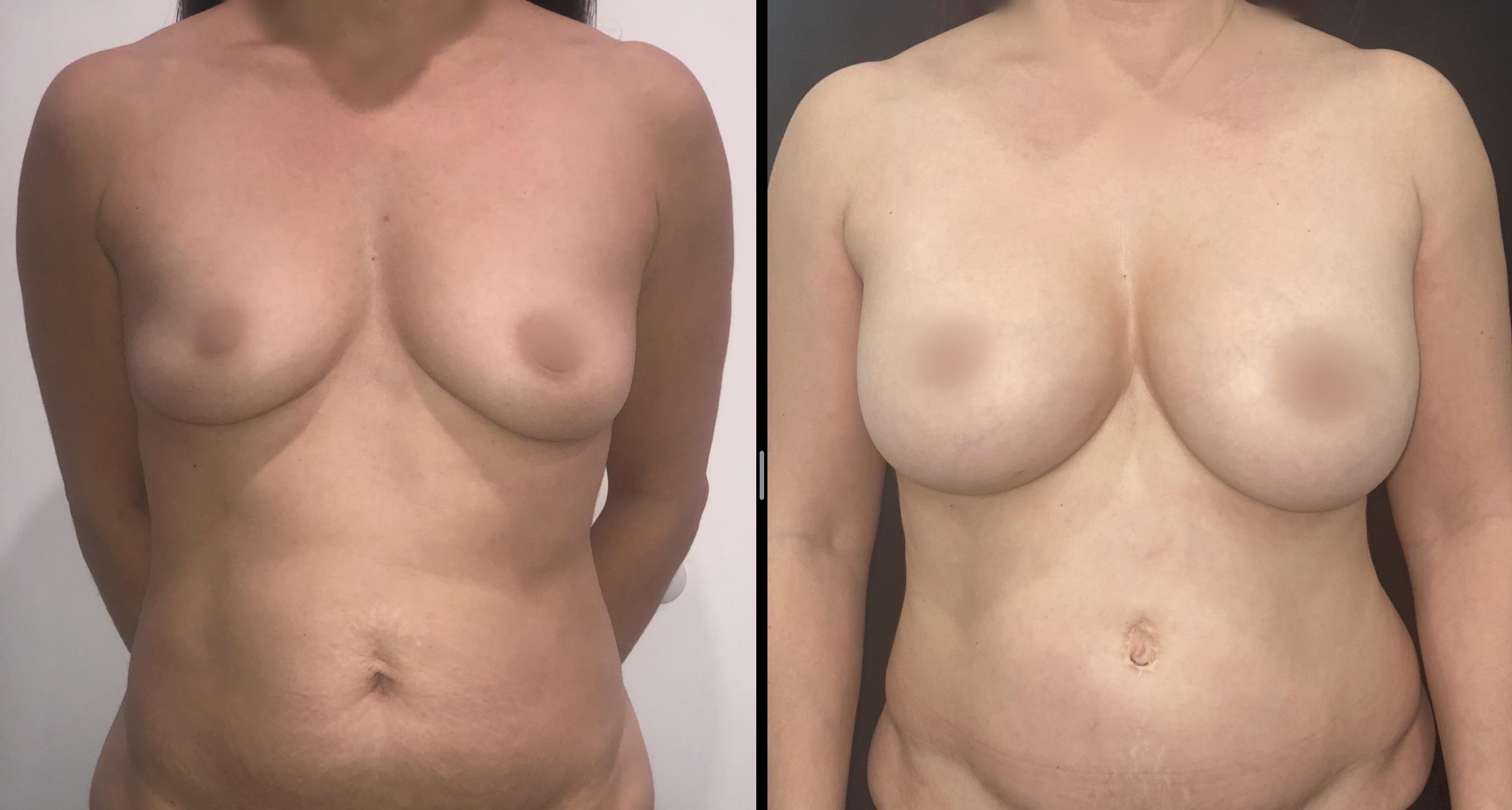
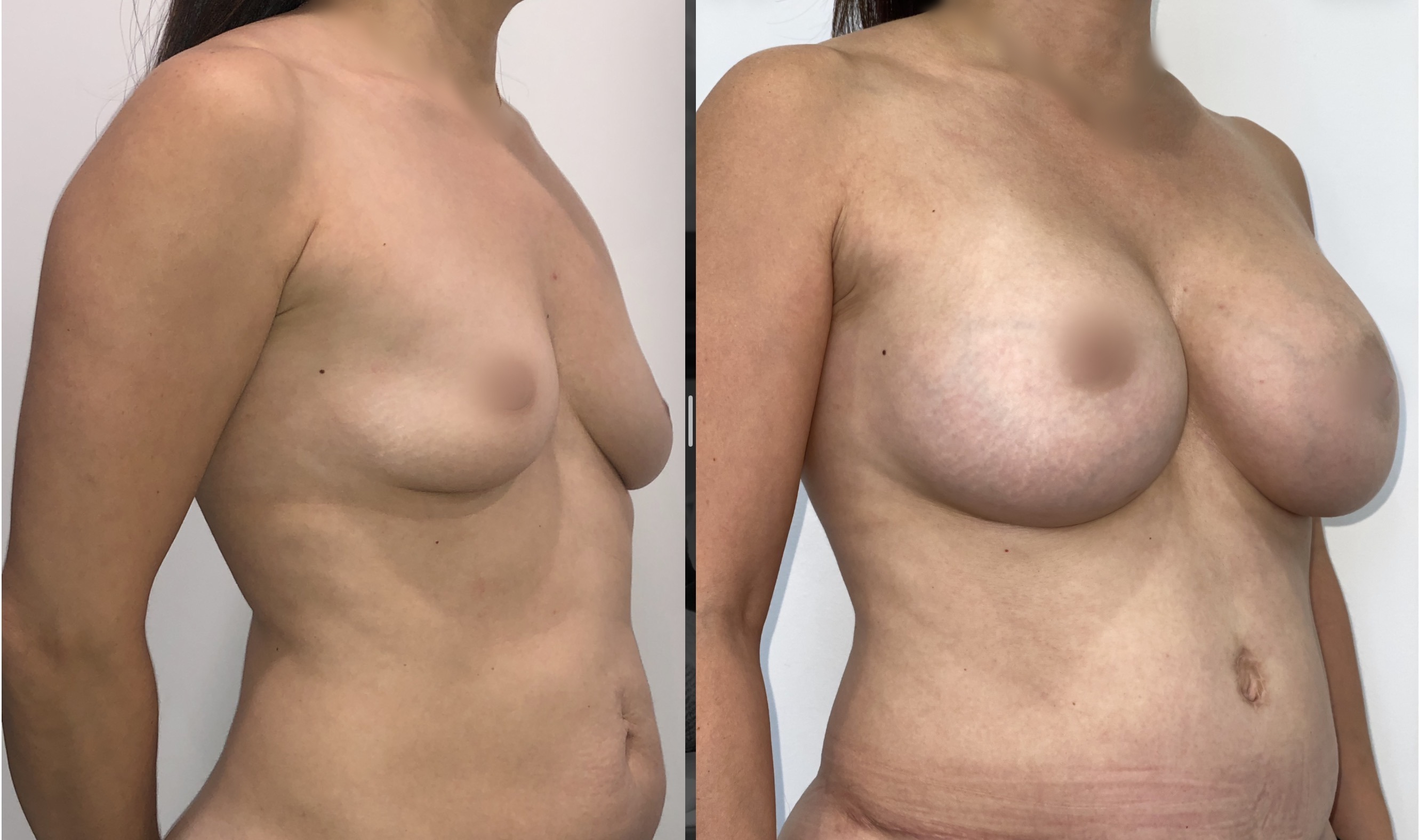
Results are unique to each patient and are never guaranteed.
Who is a candidate?
The operation is generally appropriate if you are in good general health, have finished breast development, and want more volume than your own tissue provides. Common reasons include naturally small breasts, noticeable asymmetry between sides, and volume lost after pregnancy, breastfeeding or weight change.
- You are at a stable weight and not planning a significant loss
- You are not pregnant or breastfeeding, and are at least three to six months past either
- You do not smoke, or are willing to stop well before surgery, nicotine measurably impairs wound healing
- You understand that implants are medical devices with a finite lifespan, not permanent fixtures
- Your expectations are about proportion and shape rather than a specific cup size
Breast screening history matters. If you are of an age where mammography is recommended, that imaging should be current before surgery, and you should know that implants change how future mammograms are performed, additional views are standard, and you tell the technologist you have implants.
Technique and approach
Three decisions shape the operation, and all three are made with you rather than for you.
Implant type
Silicone gel implants are the most commonly used in aesthetic breast surgery in Canada; they are softer and less prone to visible rippling than saline, particularly in patients with little natural tissue. Saline implants remain an option and are placed through a smaller incision because they are filled after insertion. Cohesive gel devices hold their shape more firmly, which suits some anatomy and not others.
Implant position
An implant can be placed above the pectoralis muscle, entirely beneath it, or in a dual-plane arrangement where the upper portion sits under muscle and the lower portion under breast tissue. Thin tissue coverage in the upper pole generally favours a submuscular or dual-plane placement, because the muscle disguises the implant edge. Patients with more of their own tissue have more freedom. The trade-off is that submuscular placement is typically more uncomfortable for the first week and can produce visible movement of the implant when the pectoralis contracts.
Incision
The incision is most often placed in the fold beneath the breast, where the scar sits hidden and the surgeon has direct control of the pocket. Alternatives run along the lower edge of the areola or through the armpit. Each leaves a scar somewhere; the question is which location suits your anatomy and which you would rather live with.
Anaesthesia and setting
Breast augmentation is performed under general anaesthesia and takes approximately one to two hours. It is normally a day procedure: you arrive in the morning and go home the same day, with someone else driving and, ideally, staying with you the first night.
Recovery, week by week
Recovery is predictable in shape even though the pace varies between people. The following is a typical course, not a promise.
Days one to three
Tightness across the chest is the dominant sensation, often described as pressure rather than sharp pain, and it is more pronounced with submuscular placement. Prescribed analgesia is used on a schedule rather than waiting for discomfort. You are up and walking the same day, short, frequent walks reduce the risk of blood clots and are more useful than bed rest.
Week one
Swelling peaks around day three and begins to settle. A surgical bra is worn continuously, including overnight. Most people stop prescription analgesia within three to five days. Desk work from home is often possible late in the first week if you are not commuting.
Weeks two to four
Return to office work is common at around two weeks. Driving resumes once you are off prescription analgesia and can perform an emergency stop and shoulder check without hesitation. Light lower-body exercise can usually restart; anything involving the chest, arms or impact does not.
Weeks four to eight
Gradual return to full activity, including upper-body training, generally begins around six weeks and is staged rather than immediate. The breasts are still settling: implants sit high initially and descend into the pocket over weeks as the tissue relaxes.
Three to six months
This is when the result becomes the result. Swelling has resolved, the implants have settled, and scars have begun the slow fade that continues for a year or more. Judging the outcome before this point is judging an intermediate state.
Results and longevity
Implants are durable but they are not lifetime devices. Manufacturers do not warrant them indefinitely, and a proportion of patients will need a further operation at some stage: for rupture, for capsular contracture, or simply because preferences change over decades. Planning on the basis that one operation is the last one is planning on an optimistic assumption.
- Volume and proportion improve immediately and are stable once swelling resolves
- Ageing, pregnancy and weight change continue to affect the breast around the implant
- Skin quality and tissue support determine how the result holds over ten and twenty years
- Periodic imaging is recommended for silicone implants to detect silent rupture
Where the aim is durability rather than an immediate result alone, the surgical plan is paired with the clinic’s non-surgical skin and scar care rather than treated as a separate concern.
Risks, stated plainly
Every operation carries risk, and a page that omits them is not informing you. The risks specific to breast augmentation are well characterised.
- Capsular contracture, scar tissue around the implant tightens and firms the breast, sometimes distorting it. The most common reason for further surgery.
- Implant rupture, silicone rupture is often silent and detected on imaging rather than by symptoms; saline rupture is obvious because the breast deflates.
- Changes in nipple and breast sensation: usually temporary, occasionally permanent, and more likely with periareolar incisions.
- Asymmetry, rippling or malposition; some asymmetry is present in every chest before surgery and cannot be entirely erased.
- Bleeding, infection and delayed healing, uncommon, and substantially more likely in smokers.
- BIA-ALCL: a rare lymphoma associated with textured implants, not breast cancer, and part of any implant discussion.
- Effects on breastfeeding; most patients can breastfeed after augmentation, but it cannot be guaranteed beforehand.
General anaesthetic risk, and the risk of blood clots, apply to this as to any surgery. Both are discussed in detail before you consent.
What the consultation involves
A Restore consultation is unhurried and conducted by the surgeon who would perform the operation, in English or French. It covers your medical history, an examination with measurements of chest width, tissue thickness and existing asymmetry, and a discussion of what those measurements permit.
You will be told what the operation cannot do as clearly as what it can. If a lift is the honest answer, or if the size you have in mind would sit poorly on your frame over a decade, that is said in the room rather than after the fact. Some consultations end with a recommendation not to operate.
Go further: the Perfect Pair Program
Breast augmentation with Dr. Guberman, paired with Aerolase for scar maturation and a curated skincare protocol.
Book Consult: Perfect PairFrequently Asked Questions
How long is recovery from breast augmentation in Montréal?
Most patients are off prescription pain medication within a few days and back to desk work in one to two weeks. Lower-body and light cardio resume at around two to four weeks, and chest work and impact are staged back in from roughly six weeks. Swelling settles over three to six months, which is when the shape is judged. These are typical ranges, not promises; the instructions given for your own case take precedence.
Does breast augmentation lift sagging breasts?
No. An implant adds volume and can fill the upper pole, but it does not raise the breast or move the nipple. Breasts that sit low are corrected by a breast lift, which removes skin and repositions the nipple, and a lift can be combined with an implant in one operation. Which of the three applies to you is decided at the examination, not from photographs.
Who performs breast augmentation in Westmount?
At Essbé Beauté, breast augmentation is planned and performed personally by Dr. Daniel S. Guberman, MD, FRCS(C), a Royal College certified plastic surgeon and a member of the Collège des médecins du Québec, permit 10577. The clinic is at 245 Victoria Avenue, Suite 10, Westmount, Montréal, and consultations are held in English and French.
Will I be able to choose my cup size?
Cup size is not a reliable unit; it varies between manufacturers and between garments. The conversation is about implant volume in cubic centimetres and how a given volume behaves on your specific chest width and tissue. Sizers and photographs of comparable anatomy are more useful than a letter.
How long do implants last?
There is no fixed expiry. Many implants remain in place and intact for well over a decade. What is honest to say is that they are not lifetime devices, and that some patients will need a further procedure at some point: for rupture, capsular contracture, or changing preference.
Can I breastfeed after breast augmentation?
Most patients can. The milk ducts and glandular tissue are generally preserved, particularly with an inframammary incision. It cannot be guaranteed in advance, and the same is true of women who have never had surgery.
Will implants interfere with mammograms?
They change how the imaging is done rather than preventing it. Additional views are used to see around the implant, and you tell the technologist you have implants when booking. Routine screening continues on the normal schedule for your age.
Above or below the muscle, which is better?
Neither is universally better. Below the muscle disguises the implant edge and suits thin tissue; above the muscle is more comfortable early and avoids visible movement when the chest contracts. The decision follows your tissue thickness and what you do physically.
When can I go back to the gym?
Lower-body and light cardio work usually resume around two to four weeks. Upper-body training, chest work and impact are staged back in from roughly six weeks. Returning early is the most common cause of prolonged swelling.
How visible is the scar?
An inframammary scar sits in the fold beneath the breast and is hidden in a bra, a bikini top and in most positions when standing. It is red and firm for several months and then fades over a year or more. It does not disappear, no scar does.
Do I need to stop smoking?
Yes. Nicotine constricts the small vessels that supply healing tissue and measurably increases the rate of wound breakdown and infection. Stopping several weeks before and after surgery is not a formality.